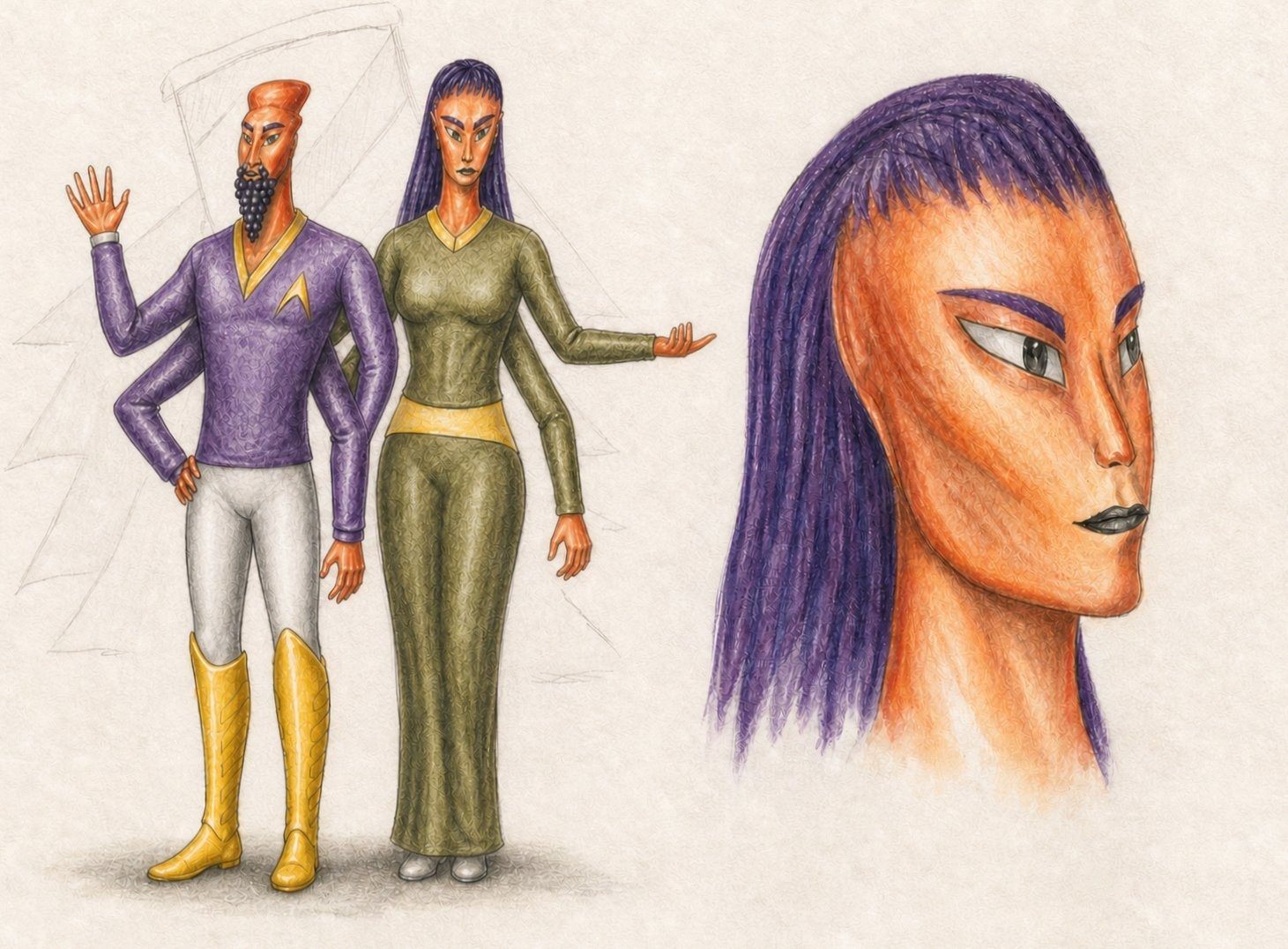
The Sohians are four-armed humanoids with a fairly settled culture. Their principal religion is the worship of the stars, and it remains influential in Sohian society: the head of the church is still the second Sohian in the country.
Most of them are arrogant. Humans they respect, holding them to be their forebears, but the other races they despise, supposing that human civilisation must be followed by the Sohian one, which will sooner or later bring the galaxy under itself.
Different Sohian tribes keep to different traditions, and the division into tribes arose in the times of the great oblivion, when the planets ceased to be in contact with one another.
Some tribes — the planets of Kego, for instance — traditionally held the leading positions. The Bivraki tribes, who fiercely resisted unification, were stripped of rights: only primitive and dirty work fell to them, and education was closed off.
The Sohian realm lies in the south of the galaxy, in sector V-15. It was founded by Kego the First, who waged a series of wars of conquest and subdued the neighbouring planets: in the age of the great empires the Sohians had been used as slaves, but after the human population died out they took the leading place in that region. Kego's empire united every Sohian planet in the sector, though he himself died without ever enjoying peace — he had ruled for over five hundred years on the costly life-extension services of the Dofaraki.
The new ruler, Kego the Second, came to the throne in 2019 hungry for glory and influence, and set his mind on spreading Sohian power across the whole sector.
Administratively the country is divided into nineteen satrapies. The emperor's power is absolute and past questioning, and it rests on three pillars — the army, the church and the gendarmerie. The elite units are called the “faceless”: on joining, a soldier renounces all individuality and devotes himself to serving the emperor.
The capital of the empire is one enormous palace complex. The imperial palace is a system of buildings in which more than five million people permanently live: officials, performers, painters, musicians and their families. The finest concerts in the empire are given here, and entry is governed by strict rules — for an official, getting inside is often the summit of a career. Dozens of smaller cities ring the palace, housing those who serve it and those waiting on an audience.
There is no industry on Patronos at all, and its nature is kept pristine — in part because the emperor is devoted to hunting. The chief event of the palace is the bride-viewing: thousands of young women come from every corner of the empire to compete for a place in the emperor's harem, and only three a year may hope for it.
The forge of the empire and its chief industrial centre belongs to one of the lesser branches of the imperial families. It is a frightfully overcrowded planet with an enormous concentration of production capacity: the air is heavily polluted and the water, without thorough treatment, undrinkable.
The wealthy residents — plant managers and valued engineers — live in complexes with central air and water purification, entered only by special pass. A large part of the population, though, are slaves and criminals herded here as cheap labour: most wear controlling collars from the Black Artel and live in vast, filthy dormitories. Tsovarinos holds more than fifteen billion inhabitants in all.
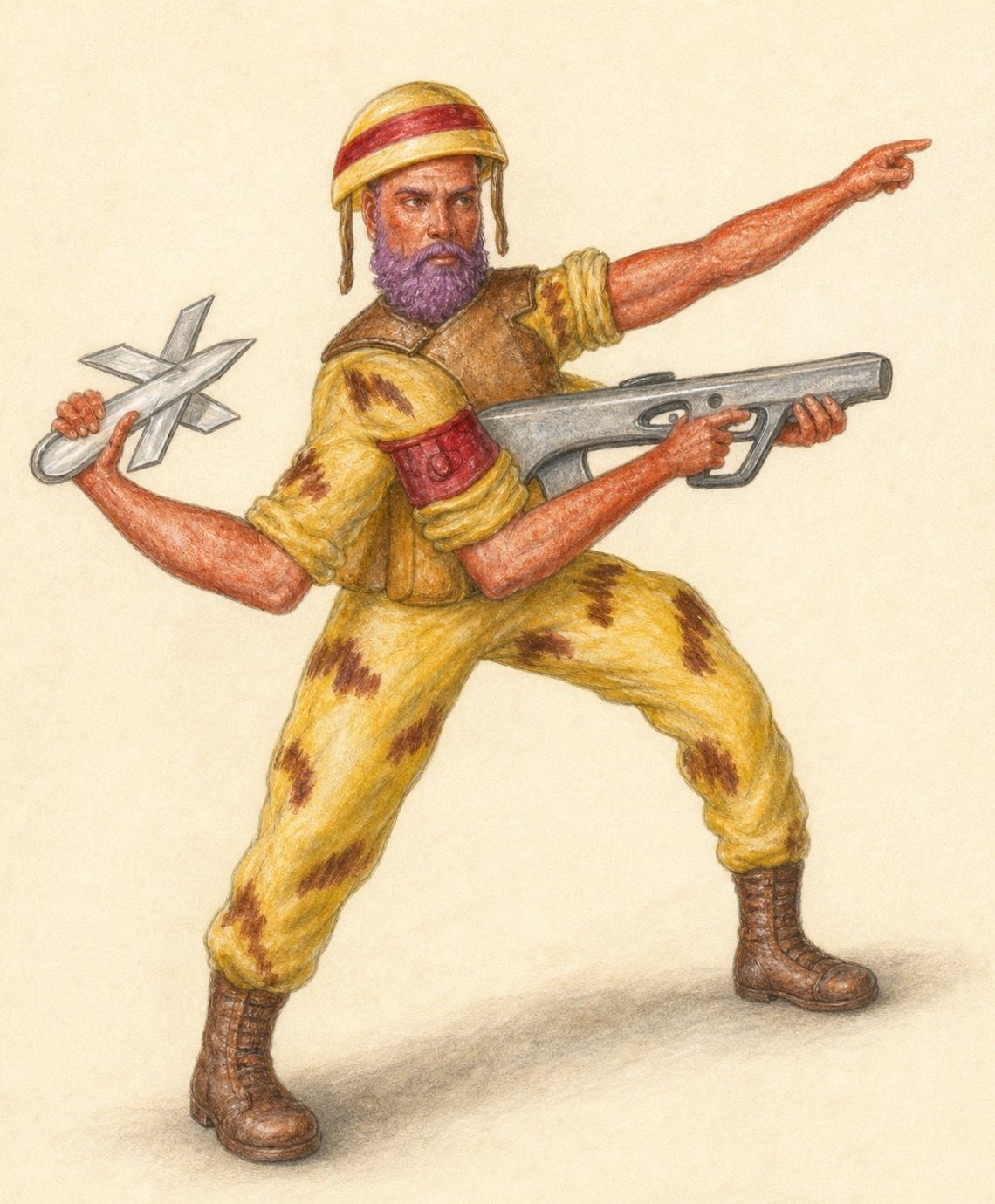
The teaching of the Sohian martyrs arose in the 1980s under the strong influence of the philosopher Kanar Bezari — as an answer to the Zherzy working their way into Sohian society. The Zherzy controlled more and more Sohians, and the race lost a measure of its independence. The martyrs set themselves against them and worked by terrorist methods, harshly and even cruelly.
The teaching quickly found supporters among broad layers, and in some Sohian countries revolutions brought the martyrs to the head of the state. They built a parallel system of power that held the real strength: a paramilitary organisation headed by well-known philosophers who interpreted the original teaching.
The Zherzy are more influential than the Sohians and effectively control the Marihays, so a conventional war against the Marihay and Zherz armies was a losing proposition from the outset. Hence the martyrs' military thinking: masses of rocket and drone weaponry that overload air defences and do damage not only to troops but to civilians. The Union of Marihay States named the martyrs one of its principal threats — on a level with the Imany and the Al-Gitulai, and for a time above them.
When the doctrine began to run into trouble, the martyrs developed another — the “fire in the field”: rather than direct confrontation, to grow anti-Zherz groupings in third countries so that the Zherzy would be scattered and unable to concentrate on their main enemy. It works to this day, and the many long wars are the proof. Yet Zherz control over part of Sohian society has not gone anywhere: some states remain wholly subject to Zherz capital.
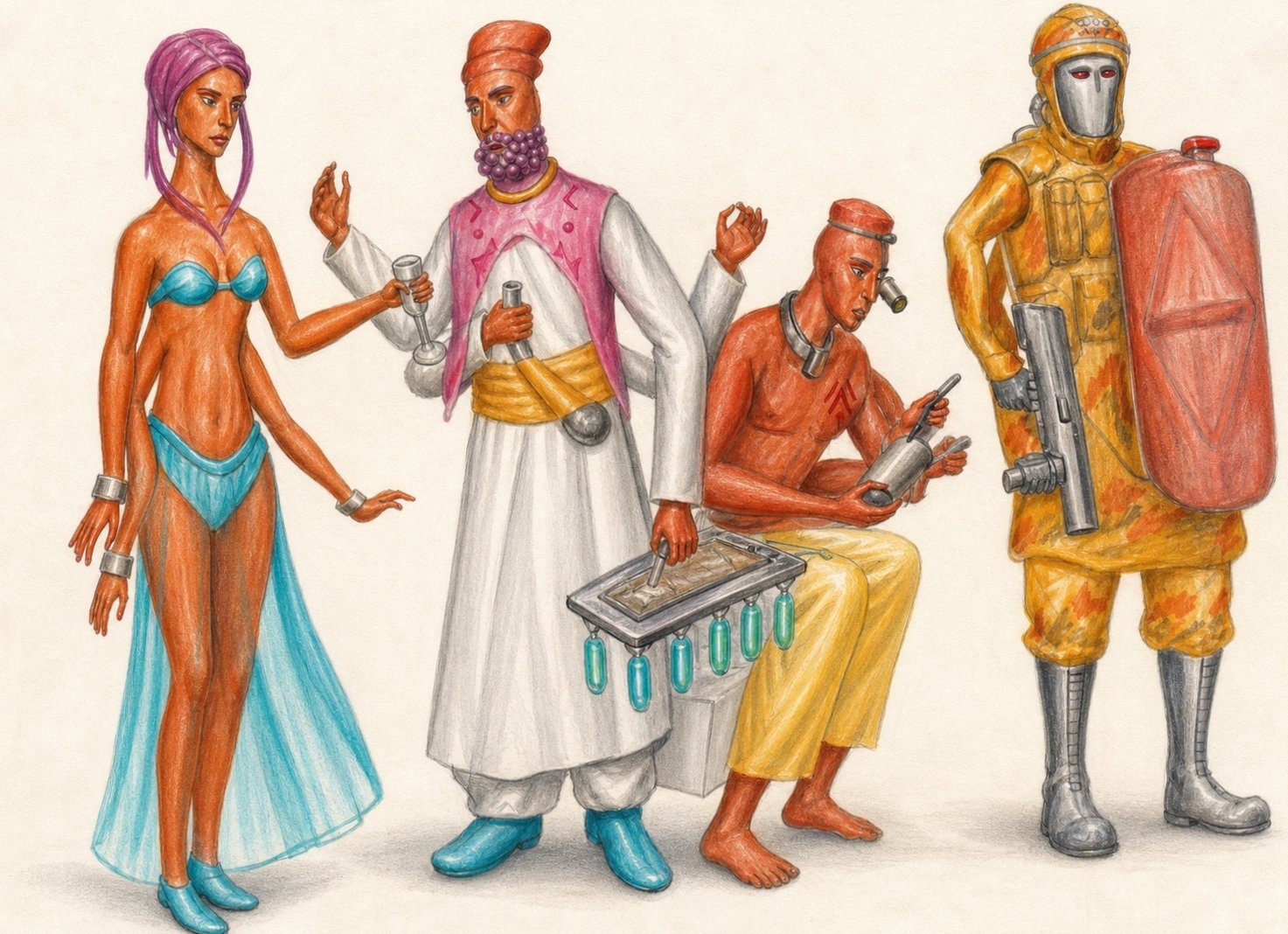
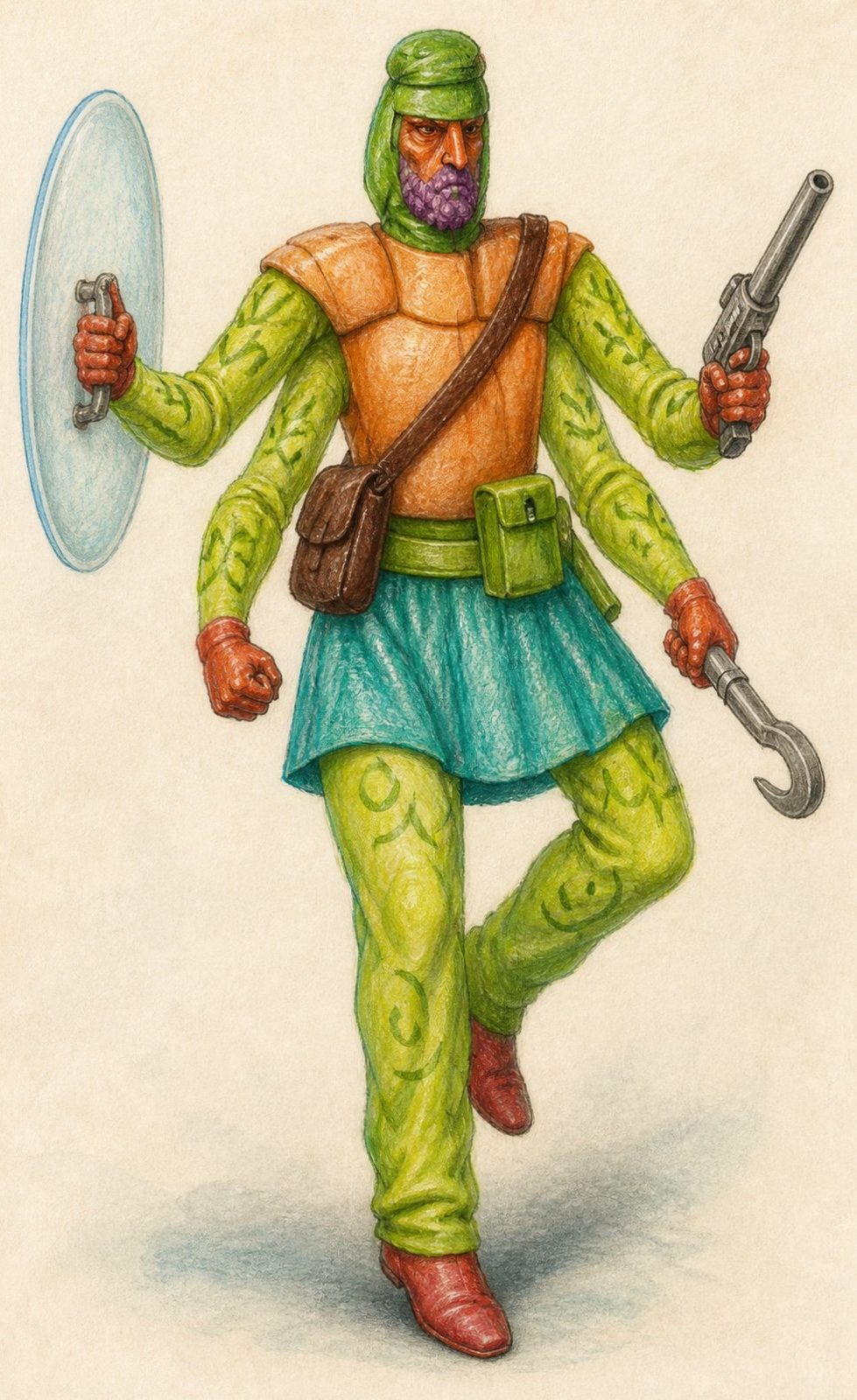
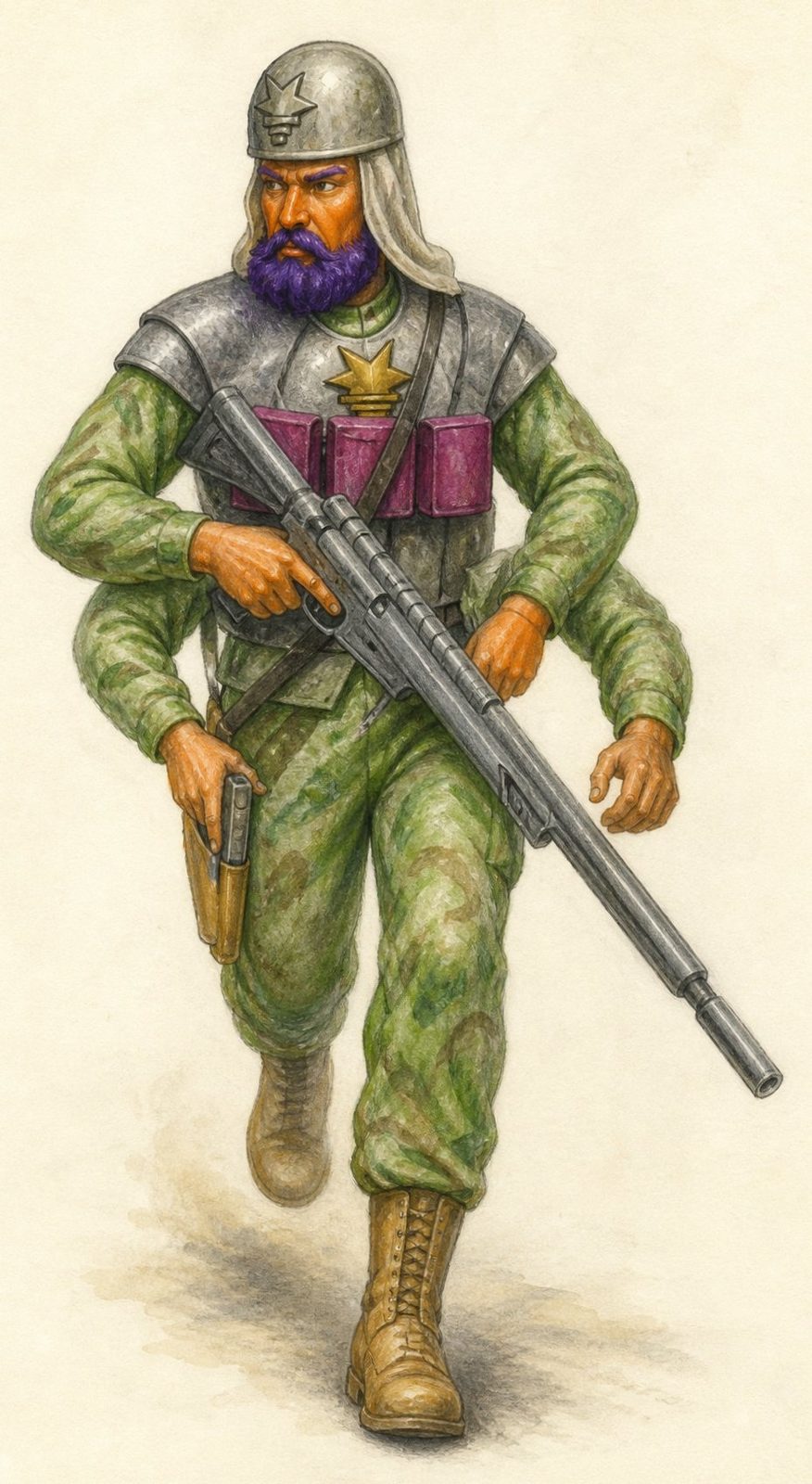
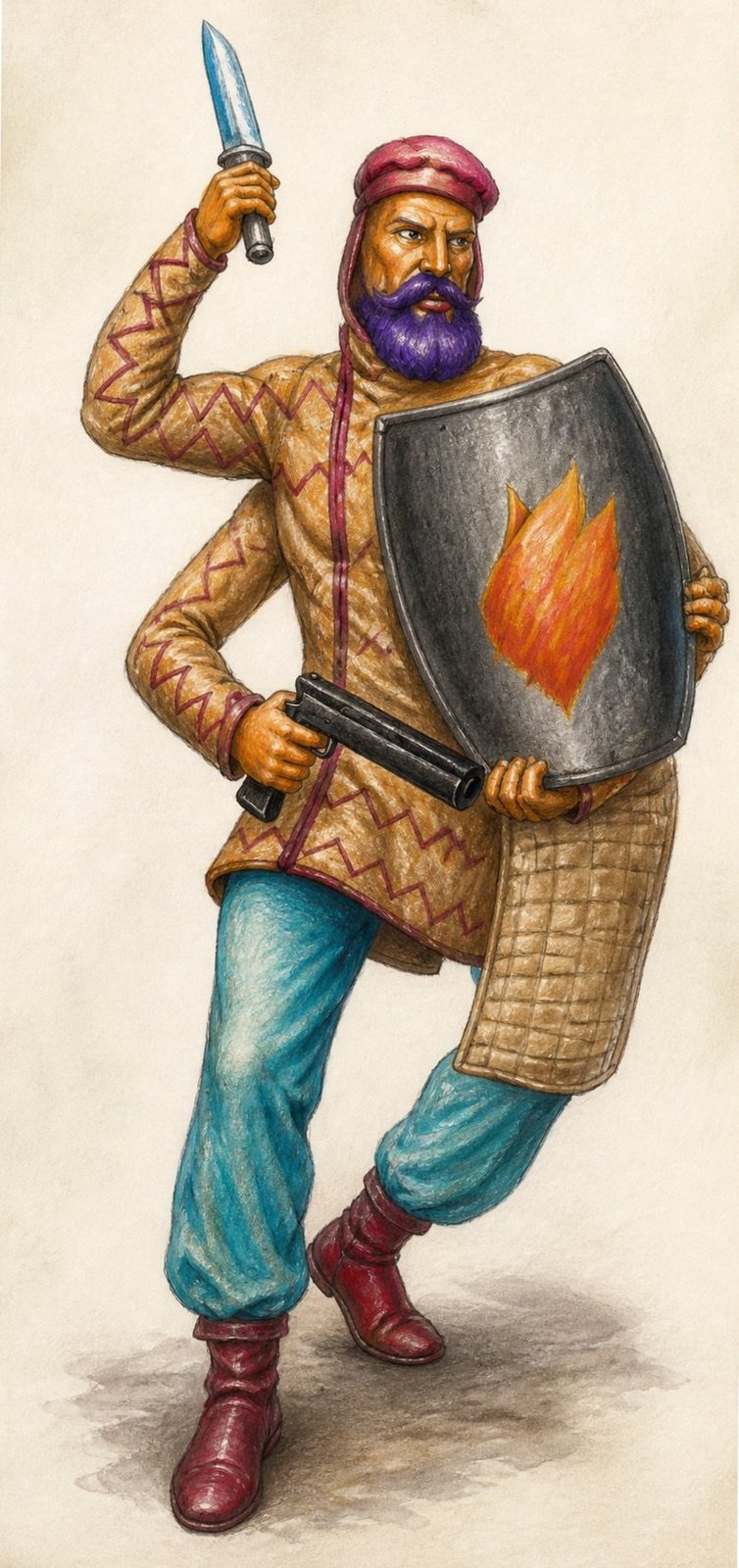
A Sohian is a humanoid with four arms, a pair to each side: orange skin, a narrow face with a high forehead, and thick hair in cool shades — the men wearing full beards.
In the order of the illustrations: a Sohian couple in everyday dress with a portrait of a Sohian woman; and a fighter of the Sohian martyrs in a spotted yellow suit, with a rifle and a throwing star.
Below, with captions, are the society of the Sohian Empire, a Sohian of the Nagoziri special forces, an Osivit soldier, and a Sohian mercenary in the service of Shaza.