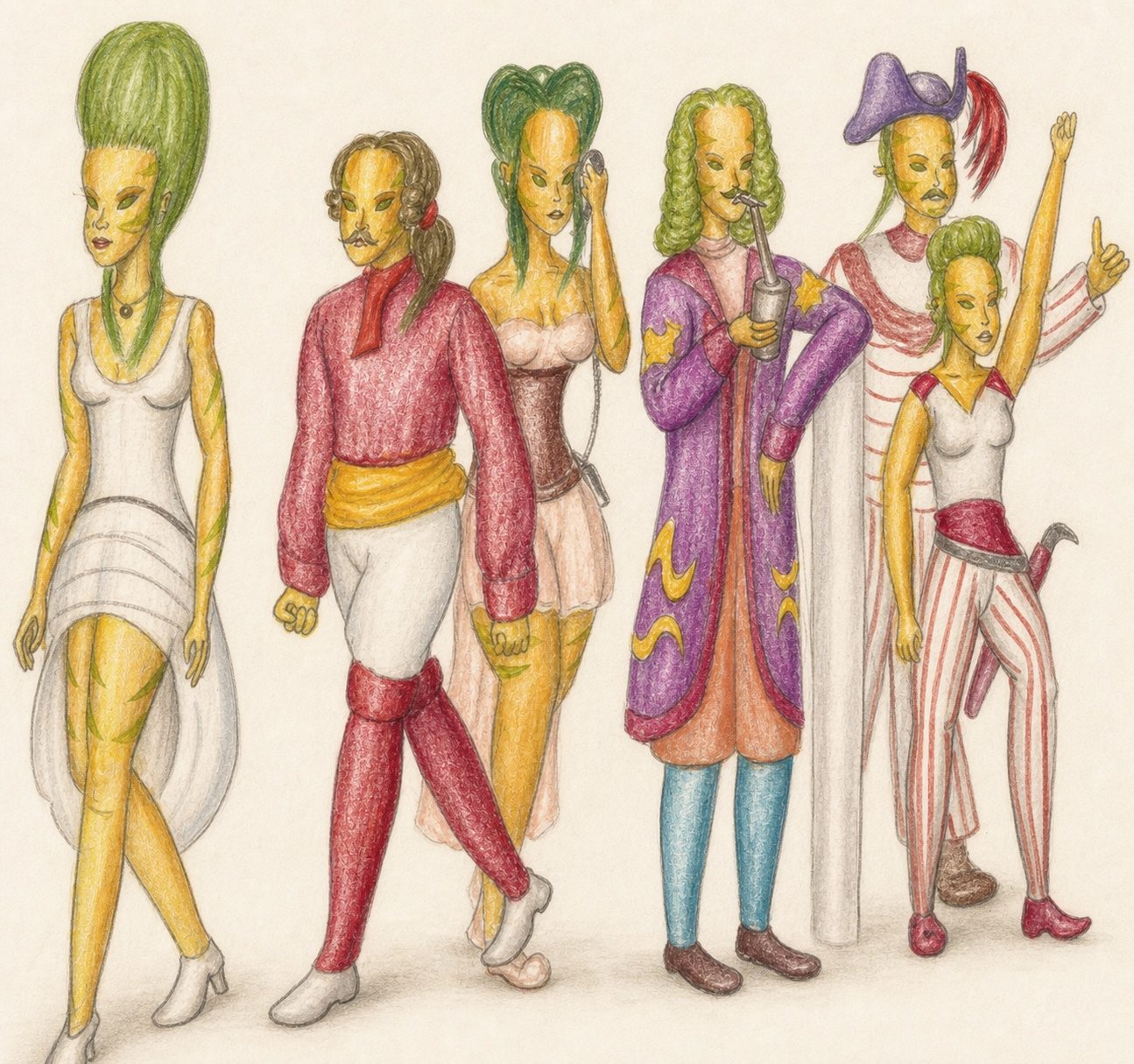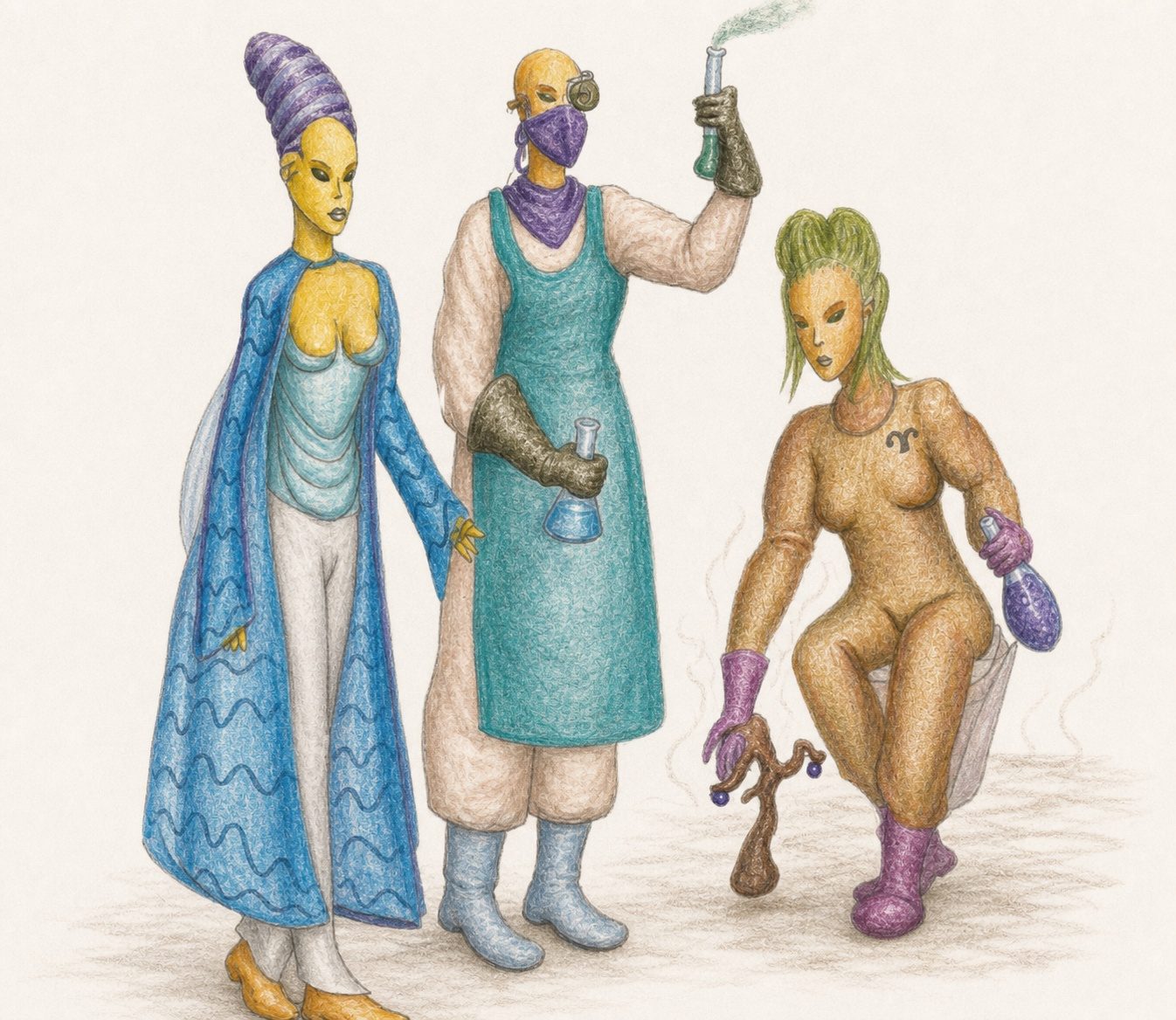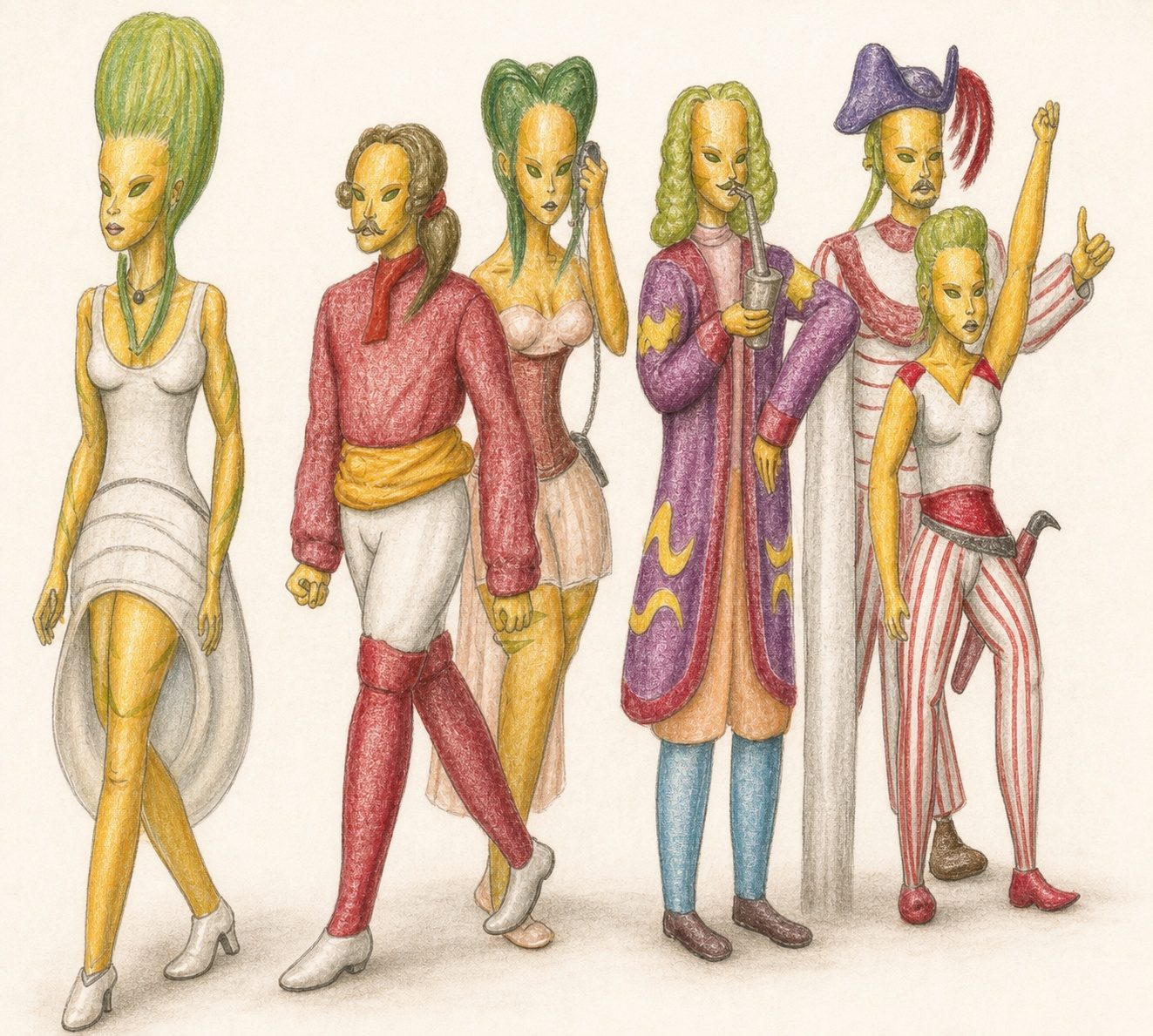
The Zhaks are a very numerous race, but one that lives relatively compactly, which is why far from everyone knows about them, unlike the Agatylais, the Araleks, or humans. Despite their humanoid form, the Zhaks are closer to the Sengi than to humans. Their origin is not precisely known, though many say they belong to one of the artificially created races.
The Zhaks prefer compact living in large, densely packed cities. Community is far more natural to them than individualism. Their social structure is quite unusual — they have no concept of family; instead there exist so-called “Threads” — a Thread is a dynasty with all its branches. Each Thread has its own specialization, and it is impossible to step outside it within Zhak society. The work of the Onityo — a secret order within Zhak society responsible for selective breeding and genetic planning — is critically important for developing certain skills, especially among the upper classes. The knowledge of this order is secret. Segregation within the order is very strong: some are responsible for weaving the Thread of the ruling houses, while others are responsible for weaving the Thread of commoners and slaves.
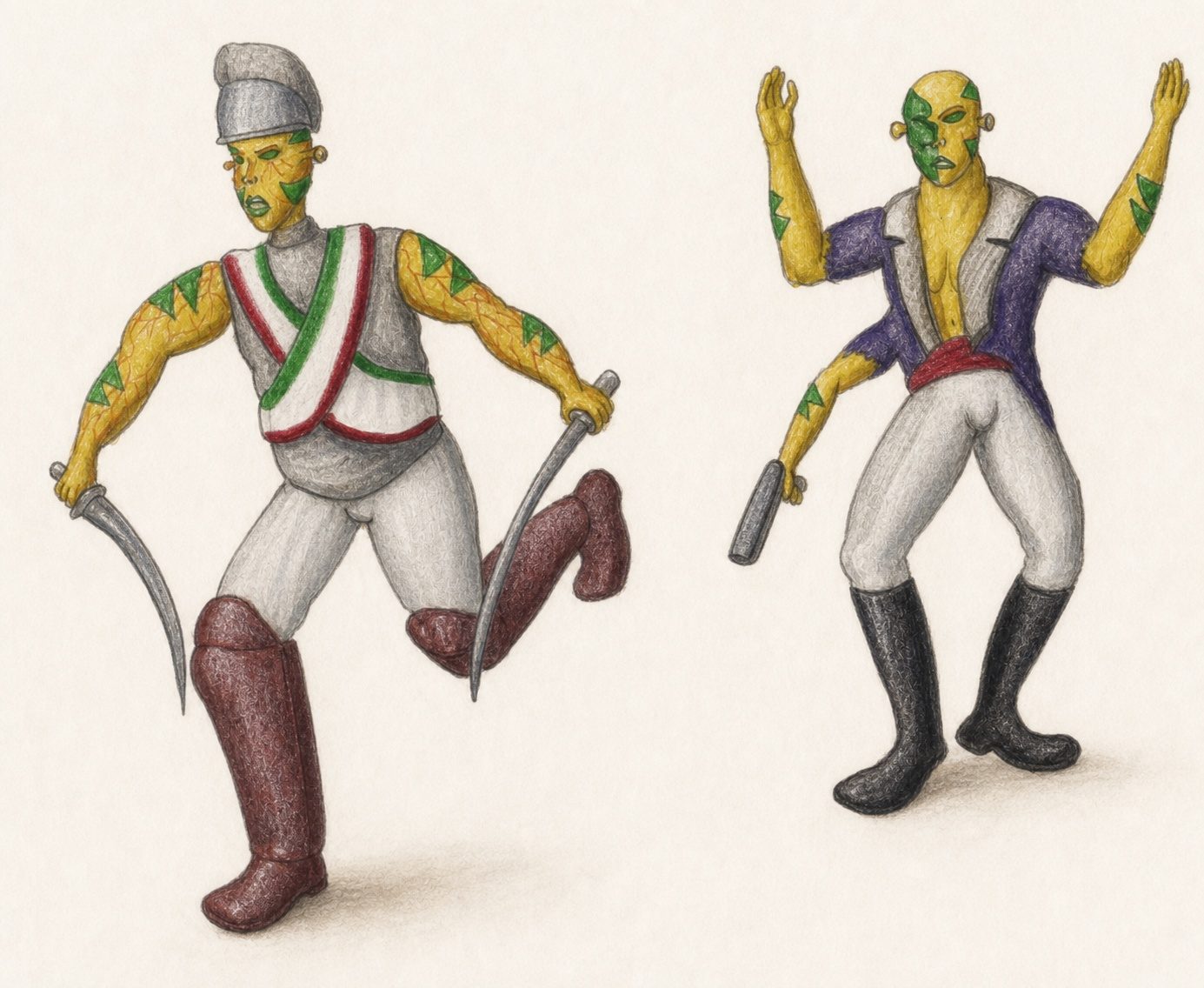
If the Onityo is responsible for genetic planning before a Zhak is born, then the order of the Oformyo is responsible for shaping a Zhak who has already been born. Like the Onityo, this is a closed order that takes part in the life of most Threads. A typical example are the soldier or slave Threads found in a number of states. Here the Oformyo most often accelerate the development of newborns during childhood and adolescence (from age 0 to 10) in order to produce ready-made recruits or slaves as quickly as possible. They can also develop particular skills — for example, in the case of soldiers, grenadiers may receive enhanced musculature, snipers enhanced eyesight, and so on.
And finally, the third secret order is the order of the Oodyo — they are responsible for growing the oodi berry. This berry has an extremely powerful effect on the Zhaks and is used by the ruling elites to control the population. Its juice, for instance, is added to the water and food of soldiers and slaves, ensuring their complete submission.
Classical Zhak society rests on the backs of these three orders and the so-called “Golden Threads” — historically the most influential dynasties. But not everyone is content with this state of affairs, and here and there within Zhak society revolutions break out, with rebels creating societies of universal equality. These rebels usually call themselves “Citizens.” Classical Zhaks try to crush these extremely dangerous precedents, though they by no means always succeed, and societies of Zhak Citizens continue to exist.
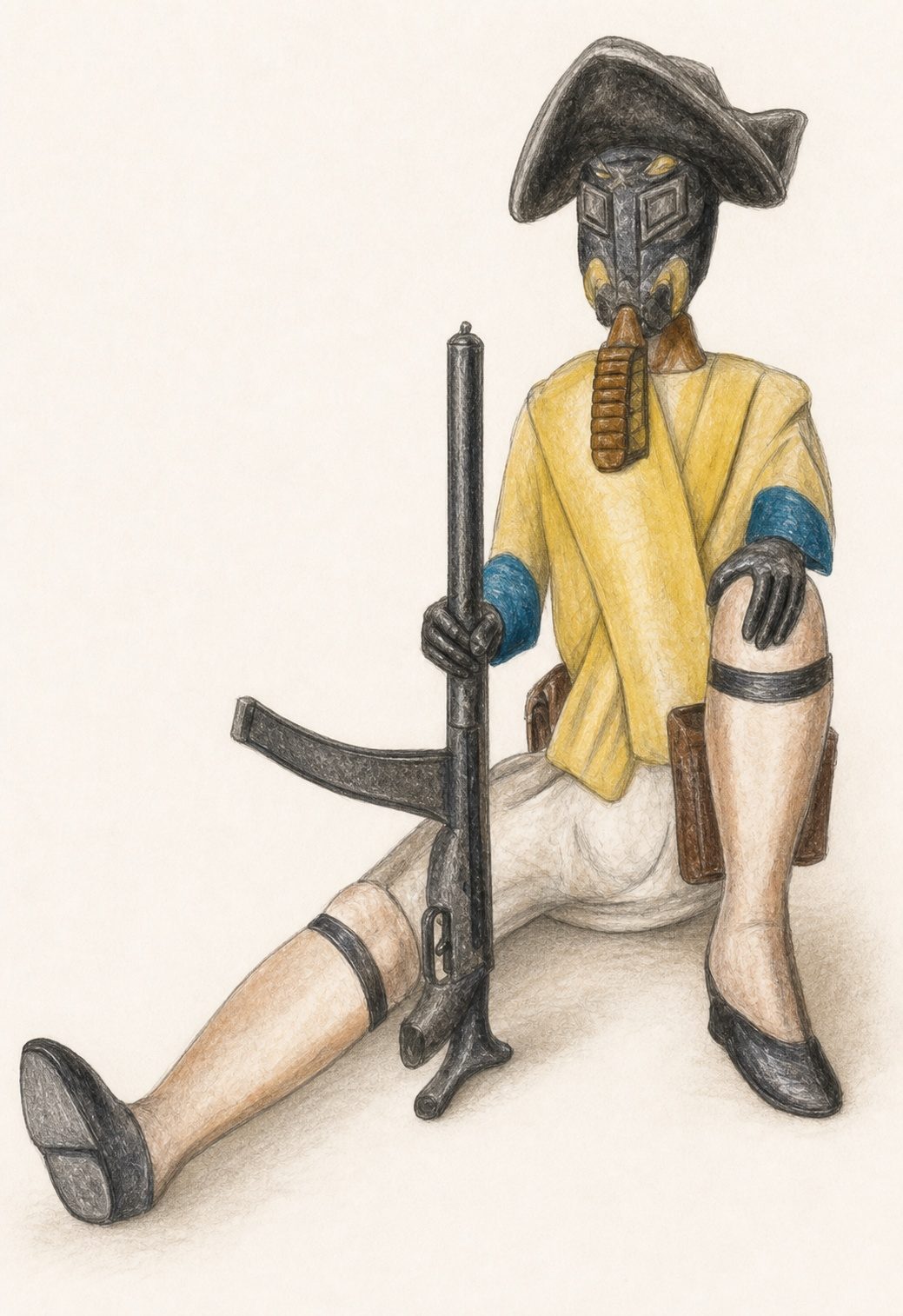
Another, far less well-known order are the “Masks” — a kind of secret police among the Zhaks. They invariably conceal their identity behind a mask. They can also often be seen carrying powerful single-shot pistols capable of piercing almost any armor. The Masks are brought in when every other method has proven ineffective. The Masks do not belong to any single Thread; as a rule they are chosen from a wide variety of Threads. What never changes, however, is their dog-like loyalty to the Golden Threads.
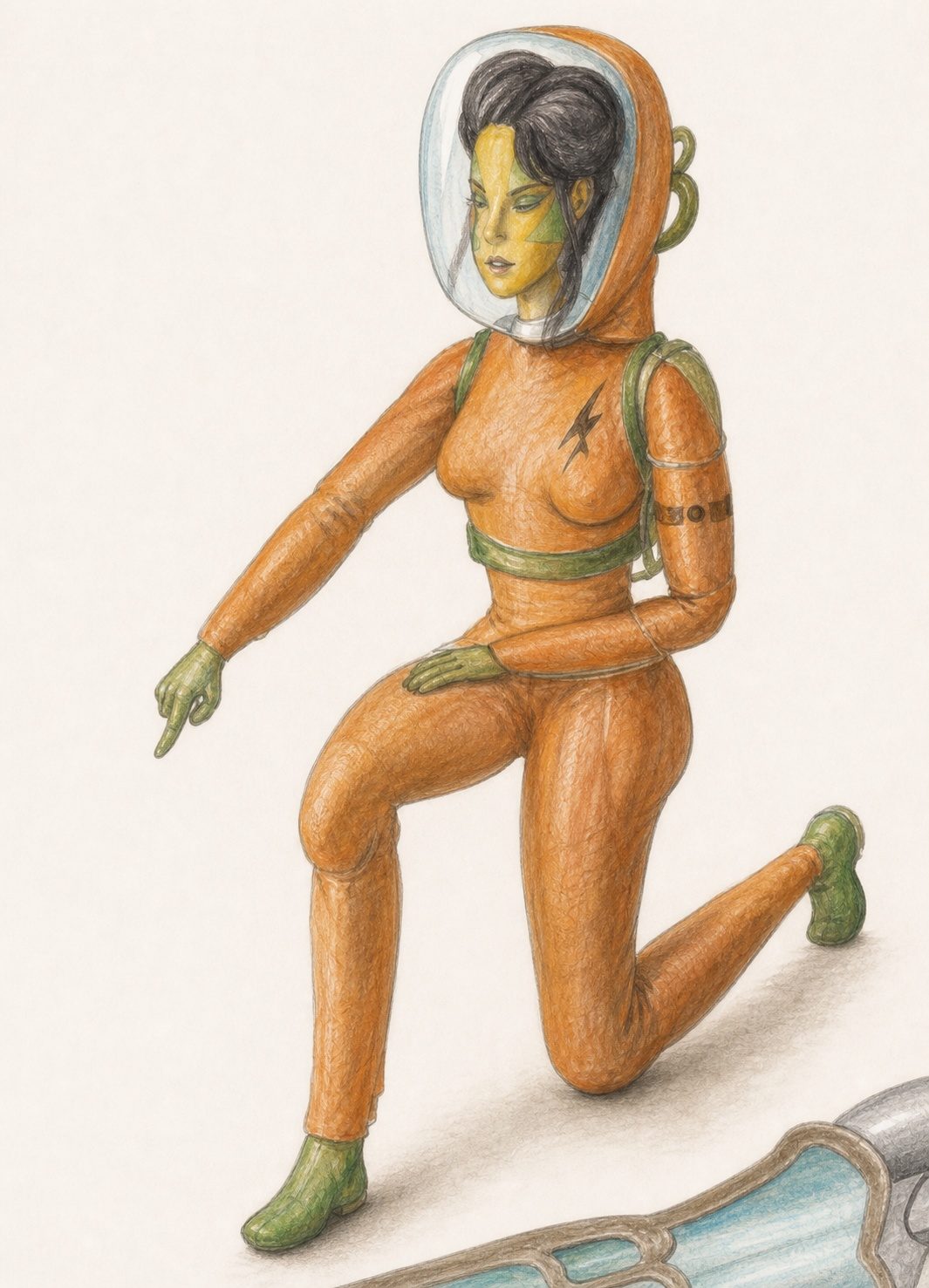
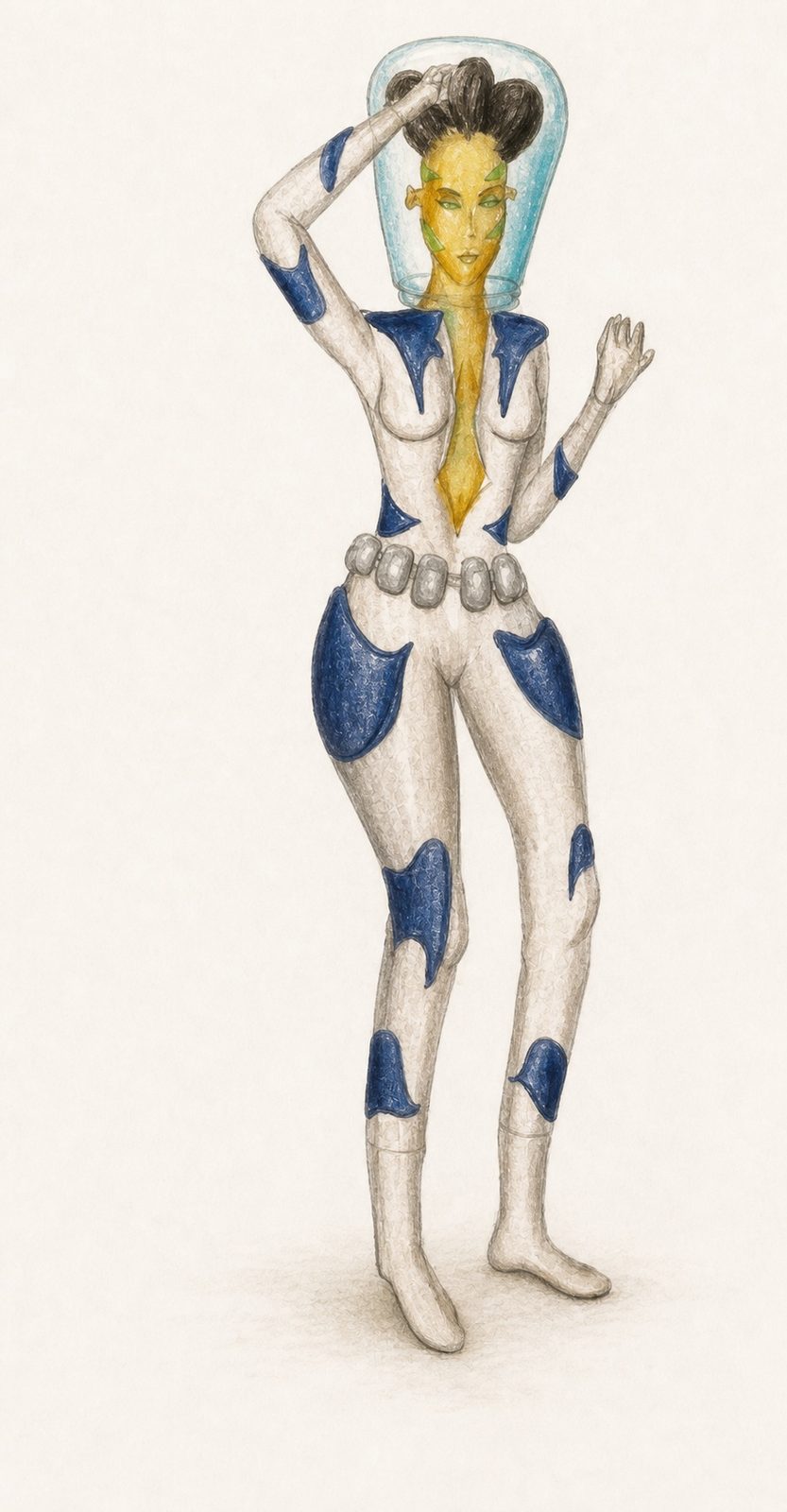
Another Thread of the Zhaks can be called the space Zhaks. Their lives are closely bound up with space. During their growth they are made more resistant to weightlessness and prolonged time in space. Although they are not the only Zhaks capable of traveling aboard starships, they account for 90 percent of this race's space transport. As a mark of distinction they dye their hair black or dark blue. The visual differences end there. Most, from a young age, are assigned to one of the vessels aboard which they receive a distinctive education. By the time they reach adulthood, these ship's apprentices become experienced spacefarers and become full members of the crew. Every aspect of their lives is regulated by the space fleet. Although the life of such Zhaks is generally hard to call easy, they are a highly respected Thread in this race's society.
Since the mid-2010s, a fascination with mutagens has been spreading through Zhak Citizen society — these enthusiasts came to be called gramuts. Such Zhaks grew themselves extra arms, thickened skin, and so on. This ran sharply counter to Thread-based society, and mutation masters began to gain more and more influence within Citizen society. The masters knew how to use medallions in such a way as to enhance their clients
The Zhak Directory arose in the mid-twenties. Its founder was Fazart, a Zhak military commander who, after the revolution triumphed in the Kingdom of Dinalye, seized power there, effectively deposing the parliament of Citizens.
Fazart first put forward the idea of the Directory shortly after seizing power. It consisted of finding a certain third path that would be neither the path of the Golden Threads nor the path of the Citizens, but an independent path uniting both currents.
The Directory was conceived as a union of Zhak states, which also included several Zhak states in a subordinate, dependent position. Its logic was as follows: there exists a Directorate — a council of heads of state. One director from each country sits on the Directorate. There exists a hereditary post of General Director, head of the Directory. There also exists a post of Honorary Director — a post Fazart reserved for himself.
The member states of the Directory coordinate policy among themselves and act along a common line, while remaining independent at the level of individual states.
Fazart's idea of the Directory arose against a backdrop of racial revival, as he watched how drastically the political landscape was changing within other racial communities, chiefly among the Marihays and the Emans. Seeing this as a great danger for the Zhaks, who were severely weakened by constant internecine wars, he sought to create a kind of Zhak superstate which, while copying certain features of the Emans and Marihay unions, would on the whole be far more tightly controlled.
Since it was meant to function as a single unified body rather than merely some amorphous union — like, for example, the Union of Marihay States, where only representatives of the parties sat in the assembly — the heads of state themselves were to sit on the Directorate.
This union, however, like any third unifying path, found little particular support either from the monarchy of the Golden Threads or from the Citizens. As a result, the very idea of the Directory was soon discredited and reduced to a minimum.
Fazart, however, did not abandon his ideas; he continued to develop them, this time by military means, bringing more and more states under the Directory's rule. Often these were not Zhak states at all, but states of other races. Yet the Directory kept growing, and the weaker Zhak states, which were in dire straits, were willing to accept the Directory in exchange for protection.
Thus, despite its initial failure, it found a second life, and Fazart soon saw himself become one of the most influential Zhaks in history.
Departments of the Directory
The Zhak Directory quickly grew a whole array of attendant departments. The most notorious of them was the Special Collegium.
The Special Collegium was in effect an external intelligence service, a foreign intelligence agency that specialized largely in operations and sabotage beyond the borders of Zhak states — more precisely, in certain territories within non-galactic states — with a single goal: to annex these countries to the Directory's territory, that is, to effectively destabilize the situation within them.
Besides the Special Collegium, another well-known organization was the Collegium of Exploration. This collegium was engaged in the discovery and exploitation of new planets, and its duties also included work in other galaxies. Although this was not written into its official mandate, in reality, activity in other galaxies — let alone for purely scientific purposes — was conducted extremely irregularly.
Although the Collegium of Exploration did have certain dealings with the Ordentsy, these mostly amounted to the Collegium sending colonists to the Ordentsy — chiefly Batyr colonists — in exchange for receiving maps of certain hyperlane routes and permission to explore various galaxies.